Why People Quit Calorie Counting (and What People Who Stick With It Do Differently)
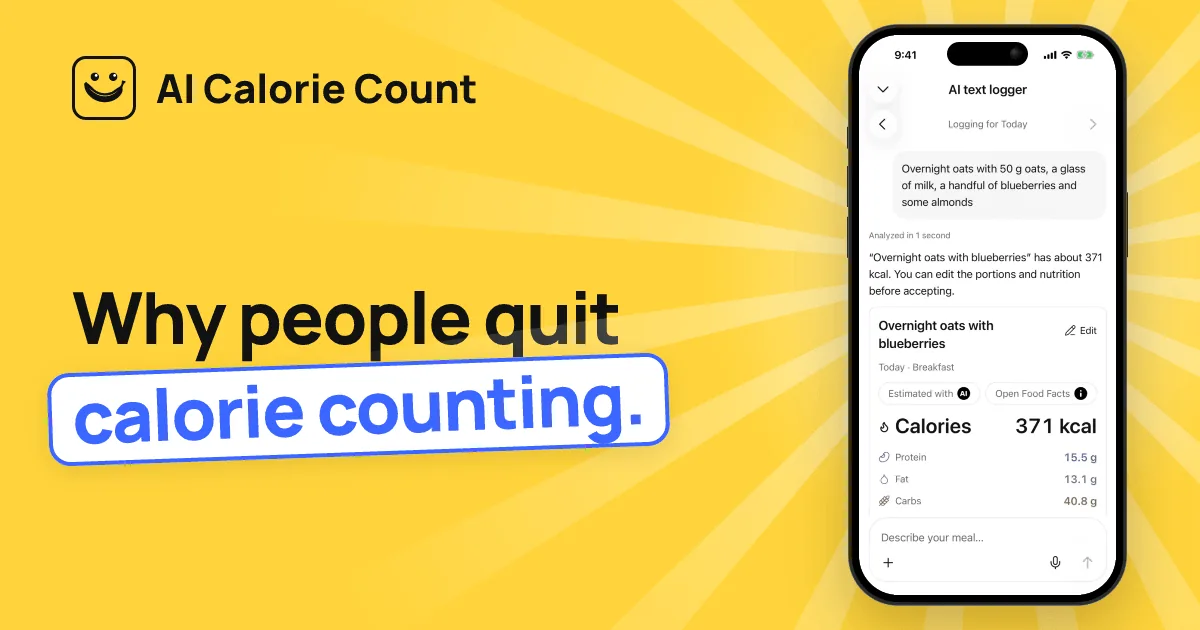
People rarely quit calorie counting because it does not work. They quit because it takes effort, because they forget to log and a few missed entries turn into “why bother”, and because they are unsure what or how much to enter. Making logging faster and accepting estimates fixes most of it.
On this page
In short
- In a study of 141 food journal users, effort was the most common complaint: too much effort, too time-consuming, tedious.
- Forgetting was the main reason for missed entries, and missed entries led some people to give up.
- Not knowing what or how much to enter, and missing foods in the database, frustrated many.
- Only 22 of 94 people who had stopped said it was because they had learned enough.
- Five habits help: log right away, reuse meals, accept estimates, log bad days too, check weekly.
What people say when they quit
Researchers in human-computer interaction surveyed 141 people who had kept a food journal, 47 who still did and 94 who had stopped, and analyzed 5,526 posts from the forums of three popular calorie counting apps (Cordeiro et al., 2015 (opens in a new tab)). Their reasons fall into a few groups.
- 31
- said it was too much effort
- 27
- said it was too time-consuming
- 16
- said it was tedious
- Effort. Looking up every food and portion takes time, several times a day.
- Forgetting. The most common reason for missed entries. After a few gaps, the diary felt pointless and some people stopped.
- Not knowing what to enter. Home-cooked dishes, restaurant meals and unclear portions. Missing or inconsistent database entries made it worse.
- Negative nudges. Some people skipped logging unhealthy food, or felt embarrassed logging in front of others, and the diary stopped reflecting reality.
Only 22 of the 94 people who had stopped said it was because they had got what they needed from it. For most, the diary was not the problem. The work around it was.
The “missed one day” spiral
A common pattern: you forget lunch on Wednesday, the day feels ruined, you stop logging until Monday, and on Monday it feels like starting over. All-or-nothing thinking turns one gap into a week. But an imperfect log still works. In a 16-week program with 449 adults, people who logged about once a day lost almost as much weight as people who logged twice a day or more, and both did far better than people who barely logged (Brockmann et al., 2026 (opens in a new tab)). Details in how often should you log meals.
5 habits of people who keep going
- Log right away. A photo before you eat takes seconds. Remembering at 10 p.m. takes minutes and is less accurate.
- Reuse what you eat often. Most people eat the same breakfasts and lunches again and again. Log them once, and the app suggests them from your history next time.
- Accept estimates. A meal logged at “about 600 kcal” is far more useful than a perfect entry you skip. See how accurate are AI calorie apps for how to make estimates better.
- Log the bad days too. The pizza night is the most useful entry of the week, because it shows where the calories really go.
- Check weekly, not hourly. Look at the weekly average and the weight trend. Single days and the daily scale jump around.
| Barrier | What helps |
|---|---|
| Too much effort | Photo or one sentence instead of searching; reuse suggestions from your history |
| Forgetting | Log at the table, before eating |
| Not sure what or how much | Log an estimate and correct it later if needed |
| Missing foods | Barcode for packaged food, photo for everything else |
| A bad day | Log it anyway and continue the next day |
The time it takes also drops with practice. In a 24-week online program, participants spent about 23 minutes a day on logging in the first month and about 15 minutes by month six (Harvey et al., 2019 (opens in a new tab)). Packaged food is faster still with the free barcode calorie scanner.
Frequently asked questions
Why is calorie counting so hard to keep up?
Mostly because of the effort: looking up foods and portions several times a day. In research, people also named forgetting and not knowing what or how much to enter. Faster logging and accepting estimates help with all three.
What should I do if I missed a day of logging?
Just continue with the next meal. A gap does not undo your progress, and an incomplete diary is still useful. Do not wait for Monday.
Do I have to count calories forever?
No. Many people track until they know their usual meals and portions well, then track only now and then, for example one week a month or when their weight trend changes.
How long does logging food take?
In a 24-week program, about 23 minutes a day in the first month and about 15 minutes by month six. A photo or a suggestion from your history takes seconds.
Is it okay to log estimates instead of exact numbers?
Yes. Regular estimates are more useful than occasional perfect entries. Check portions now and then, especially for oils, nuts and cheese.
Sources
- Cordeiro et al. (2015): Barriers and negative nudges: exploring challenges in food journaling. CHI 2015
- Brockmann et al. (2026): Within-day patterns of self-monitoring dietary intake and weight loss in a behavioral weight management program. Obes Sci Pract
- Harvey et al. (2019): Log often, lose more: electronic dietary self-monitoring for weight loss. Obesity
Published · Updated
This article is general information, not medical advice. If you are pregnant, have a medical condition or an eating disorder, talk to a doctor before changing how you eat.