How Accurate Are AI Calorie Apps? An NIH Test Found They Missed 250 to 345 Calories per Meal
Photo calorie apps are useful but not exact: in an NIH test of 102 meals with weighed ingredients, four popular apps underestimated calories by about 250 to 345 kcal per meal on average. Most of the gap was fat, about 30 g per meal, which is often invisible in a photo. The results are preliminary conference data, but the lesson is clear: treat a photo estimate as a starting point and check it.
On this page
In short
- Four photo apps missed about 250 to 345 kcal per meal on average in an NIH test.
- Fat was underestimated by about 30 g per meal. Carbohydrates were estimated most consistently.
- The data was presented at a conference in July 2026 and is not yet peer reviewed.
- Checking portions and adding hidden oil, butter and sauces closes most of the gap.
What the NIH test did and found
Researchers at the National Institute of Diabetes and Digestive and Kidney Diseases (NIDDK), part of the NIH, used meals from a diet study at the NIH Clinical Center. Every ingredient had been weighed, so the true calories were known. They photographed 102 meals and gave the photos to four popular photo-based calorie apps. The results were presented at NUTRITION 2026, the annual meeting of the American Society for Nutrition, in July 2026 (Newswise (opens in a new tab)).
- 102
- meals with weighed ingredients
- 250 to 345 kcal
- average underestimate per meal, depending on the app
- ≈ 30 g
- fat missed per meal
- All four apps underestimated calories on average, by about 250 to 345 kcal per meal.
- Fat was underestimated by about 30 g per meal, which alone is around 270 kcal.
- Carbohydrate estimates were the most consistent.
- A follow-up with more than 200 additional meals suggests that high-fat (ketogenic) meals are estimated worst. That part is early data.
Why cameras miss fat
A camera sees surfaces. It can recognize a chicken breast, rice and broccoli, and guess their size from the plate. It cannot see the tablespoon of oil the chicken was fried in (about 90 kcal), the butter melted into the rice or the cream in the sauce. Fat has 9 kcal per gram, more than twice as much as protein or carbohydrates, so a little hidden fat moves the total a lot.
| Extra | Amount | Calories |
|---|---|---|
| Oil in the pan | 1 tablespoon (10 g) | 90 kcal |
| Butter on vegetables or rice | 10 g | 75 kcal |
| Mayonnaise | 1 tablespoon (15 g) | 113 kcal |
| Pesto stirred into pasta | 30 g | 163 kcal |
| Vinaigrette on a salad | 30 g | 86 kcal |
Calculated from BLS 4.0 and the Swiss Food Composition Database.
6 ways to get a better estimate
- Use good light. Daylight or a bright room, no flash glare. Dark photos hide portion edges.
- Get the whole plate in the frame, shot from slightly above, with nothing cut off.
- Mention what you cannot see. Oil, butter, cream, sugar in the coffee. A sentence like “fried in a tablespoon of olive oil” fixes the biggest gap.
- Check the portion. If the estimate says 150 g of pasta and you know you cooked 100 g dry (about 250 g cooked), change it.
- Correct every food that is wrong, not just the total. Then the saved meal is right the next time too.
- Use the barcode for packaged food. The label is better than any photo guess.
Photo, manual entry or guessing: where each one goes wrong
No method is perfect. What matters is knowing where each one tends to fail:
| Method | Typical error | How to reduce it |
|---|---|---|
| Photo estimate | Misses hidden fat and misjudges portion size | Add oils and sauces, check the grams |
| Manual entry from a database | Wrong or duplicate entries, guessed amounts | Use a curated food table or the barcode, weigh now and then |
| Guessing from memory | Forgotten snacks and drinks, portions remembered smaller | Log right after eating, not in the evening |
Memory is the weakest link. In a classic study, people who said they could not lose weight on few calories had underreported their intake by 47% (Lichtman et al., 1992 (opens in a new tab)). In food journaling research, wrong or missing database entries and not knowing how much to enter were among the main frustrations (Cordeiro et al., 2015 (opens in a new tab)). A photo taken right away fixes the forgetting. Checking the estimate fixes the rest. More in why people quit calorie counting.
Frequently asked questions
Are AI calorie apps accurate?
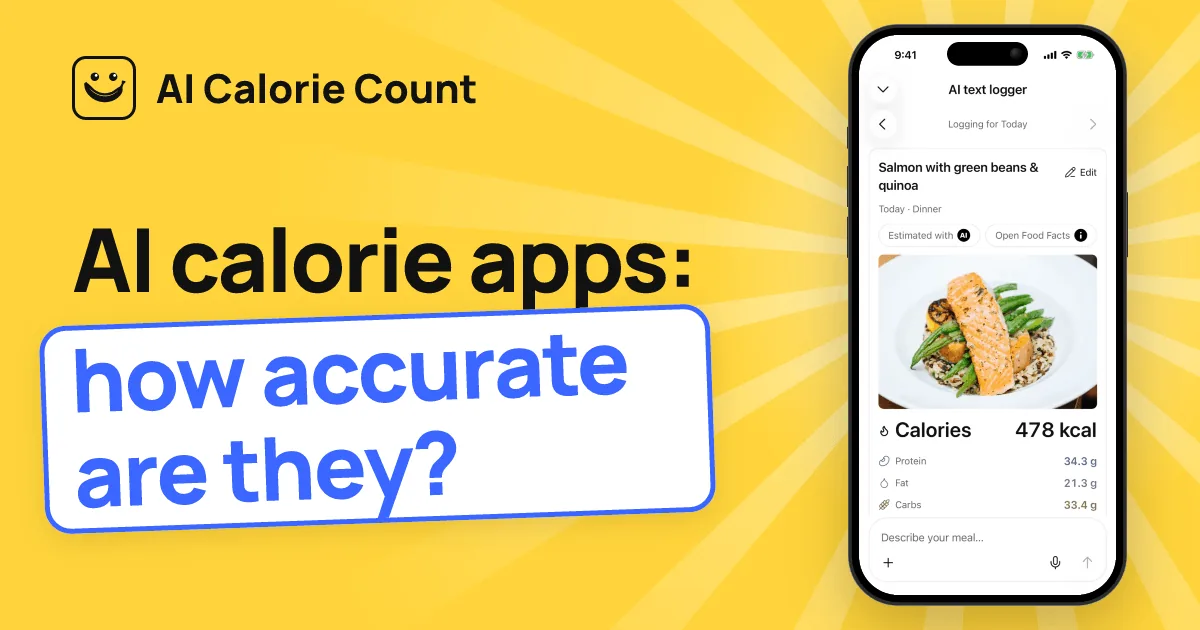
They are good at recognizing foods but often underestimate calories. In an NIH test, four apps came in about 250 to 345 kcal low per meal on average, mainly because they missed fat. Checking portions and adding hidden ingredients makes them much more useful.
Which AI calorie app is the most accurate?
There is no peer-reviewed ranking yet. The NIH results are preliminary. Whatever app you use, the estimate gets better when you check the portions and add what the camera cannot see.
Is a photo estimate better than not tracking at all?
For most people, yes. A quick photo right after eating records meals and snacks you would otherwise forget, and forgotten food is the biggest source of error in self-reported intake.
Do AI apps overestimate or underestimate calories?
In the NIH test, all four apps underestimated on average. High-fat meals were the hardest, because fat is often hidden in cooking oil, butter and sauces.
Was AI Calorie Count part of the NIH test?
No. We do not claim to be more accurate than the apps in the test. That is why the app shows its estimate per food and makes correcting it quick.
Sources
- Newswise / American Society for Nutrition (2026): Photo-based calorie tracking apps may underestimate energy in meals
- HealthDay (2026): How accurate are photo-based calorie apps? 4 are put to the test
- Lichtman et al. (1992): Discrepancy between self-reported and actual caloric intake and exercise in obese subjects. N Engl J Med
- Cordeiro et al. (2015): Barriers and negative nudges: exploring challenges in food journaling. CHI 2015
Published · Updated
This article is general information, not medical advice. If you are pregnant, have a medical condition or an eating disorder, talk to a doctor before changing how you eat.