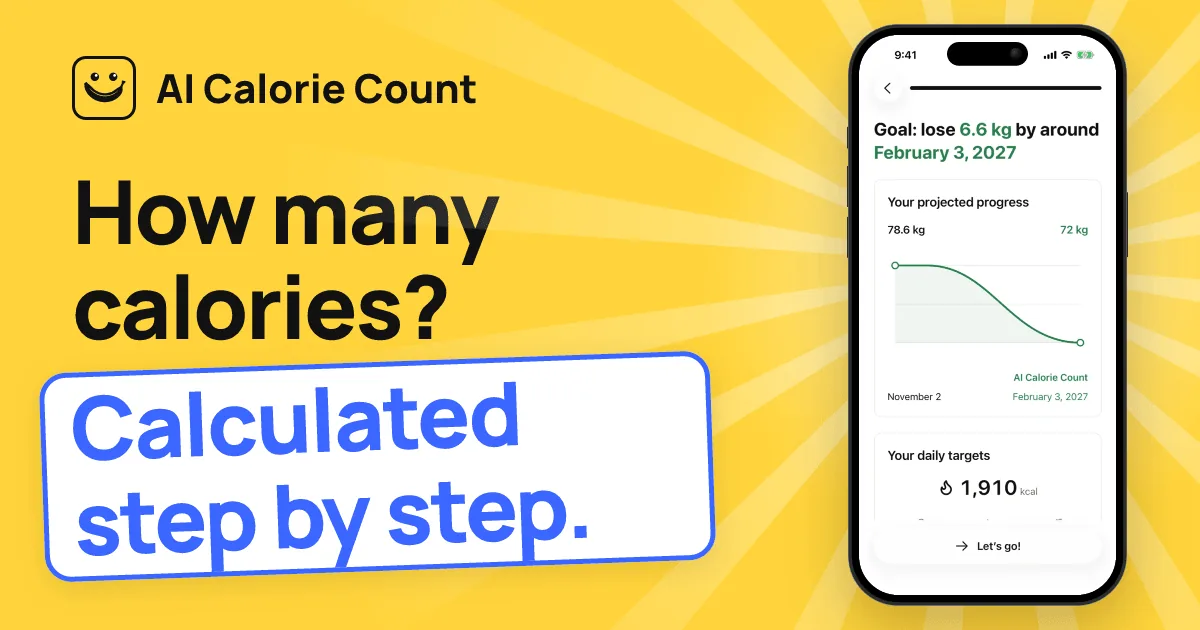
How Many Calories Should I Eat? Your Number, Calculated Step by Step
Your daily calorie target is your resting calories, multiplied by how active you are, minus a deficit if you want to lose weight. For a 35-year-old woman who is 165 cm tall, weighs 75 kg and moves a little during the day, that is about 2310 kcal to keep her weight and about 1760 kcal to lose 0.5 kg a week.
On this page
In short
- Step 1: resting calories with the Mifflin-St Jeor equation.
- Step 2: multiply by your activity level (PAL), usually 1.4 to 2.0.
- Step 3: subtract about 550 kcal a day for 0.5 kg a week.
- The result is a starting point. Check your weight trend after 2 to 3 weeks and adjust.
- Without medical supervision, stay above about 1200 kcal (women) or 1500 kcal (men).
Step 1: your resting calories
Resting calories are what your body burns doing nothing: breathing, keeping warm, running your organs. The most widely used formula for them is the Mifflin-St Jeor equation from 1990, developed with 498 healthy adults aged 19 to 78 (Mifflin et al., 1990 (opens in a new tab)).
| For | Formula |
|---|---|
| Men | 10 × weight (kg) + 6.25 × height (cm) − 5 × age + 5 |
| Women | 10 × weight (kg) + 6.25 × height (cm) − 5 × age − 161 |
Example: a woman, 35 years, 165 cm, 75 kg. 10 × 75 + 6.25 × 165 − 5 × 35 − 161 = 1445 kcal a day at rest.
Step 2: multiply by your activity level
Nobody spends the day lying still. The physical activity level (PAL) says how much more than your resting calories you burn on a typical day. The FAO, WHO and UNU group adults into sedentary or light activity (PAL 1.40 to 1.69), active or moderately active (1.70 to 1.99) and vigorous (2.00 to 2.40) (FAO/WHO/UNU, 2004 (opens in a new tab)). Our calorie calculator and the app use four steps from 1.4 to 2.0.
| Your typical day | PAL | Calories to keep your weight |
|---|---|---|
| Mostly sitting, little walking | 1.4 | 2020 kcal |
| Sitting, with some walking or standing | 1.6 | 2310 kcal |
| On your feet much of the day, or regular sport | 1.8 | 2600 kcal |
| Physical job or hard training most days | 2.0 | 2890 kcal |
Rounded to 10 kcal, as the app shows its targets.
Step 3: subtract a deficit
A common rule says a kilogram of body fat holds about 7700 kcal. Losing 0.5 kg a week then takes 0.5 × 7700 / 7 = 550 kcal less per day. The rule is a simplification: as you lose weight, your body burns less, so the same deficit loses less over time (Hall et al., 2011 (opens in a new tab)). For the first months it is a useful starting point.
| Weekly pace | Deficit per day | Daily target |
|---|---|---|
| 0.25 kg | 275 kcal | 2040 kcal |
| 0.5 kg | 550 kcal | 1760 kcal |
| 0.75 kg | 825 kcal | 1490 kcal |
Should you eat back exercise calories?
If you used a low activity level in step 2, your workouts are not in your target yet, so eating some of them back is reasonable. Be careful with the number your watch shows. In a Stanford test of seven wrist devices, none measured energy burned with an error below 20% (Shcherbina et al., 2017 (opens in a new tab)). A safe habit is to count part of it, not all of it, and let your weight trend tell you whether that works.
You can estimate a workout with the calories burned calculator or the steps to calories converter.
Treat the number as a starting point
Every formula is an average. Your real needs can be a few hundred calories higher or lower. The way to find out is simple:
- Eat at your target for 2 to 3 weeks and log what you eat.
- Weigh yourself a few times a week at the same time of day and look at the trend, not single days.
- If you lose clearly slower than planned, lower the target by about 100 to 200 kcal. If you lose much faster, raise it.
- Recheck after another 2 to 3 weeks. Also recalculate after every 5 kg lost, because resting calories fall with your weight.
Logging honestly matters more than the formula. Most people eat more than they write down, as the research in 7 calorie myths shows.
Frequently asked questions
How many calories should I eat to lose weight?
Your maintenance calories minus about 275 to 825 kcal a day, for 0.25 to 0.75 kg a week. For the woman in the example that is 1490 to 2040 kcal. Your own number depends on your age, height, weight and activity, so calculate it with the calorie calculator.
What is the difference between BMR and TDEE?
BMR (basal metabolic rate) is roughly what you burn at rest, step 1 here. TDEE (total daily energy expenditure) is what you burn on a whole day including movement: BMR times your activity level, step 2.
How accurate is the Mifflin-St Jeor equation?
It is one of the most accurate simple formulas for healthy adults, but it gives an average. Individual results can differ by a few hundred calories, which is why you check your weight trend and adjust.
Why am I not losing weight at my calorie target?
Usually because the intake is higher than logged (snacks, drinks, oil, weekends), or the activity level was set too high. Check two to three weeks of honest logs before lowering the target.
What does kcal mean?
kcal is short for kilocalorie, the unit for energy in food. In everyday language people just say calories.
Sources
- Mifflin et al. (1990): A new predictive equation for resting energy expenditure in healthy individuals. Am J Clin Nutr
- FAO/WHO/UNU (2004): Human energy requirements, chapter 5: Energy requirements of adults
- Hall et al. (2011): Quantification of the effect of energy imbalance on bodyweight. Lancet
- Shcherbina et al. (2017): Accuracy in wrist-worn, sensor-based measurements of heart rate and energy expenditure in a diverse cohort. J Pers Med
- Harvard Health Publishing: Calorie counting made easy
Published · Updated
This article is general information, not medical advice. If you are pregnant, have a medical condition or an eating disorder, talk to a doctor before changing how you eat.